
Compound Interest Calculator: How to See the Power of Long-Term Growth
Compound interest is one of the most important ideas in saving and investing.
In simple terms, it means you earn returns not only on the money you put in, but also on the returns that have already built up over time. That is why compounding can make such a big difference over the long term.
A compound interest calculator is a useful way to see how this works in practice. It helps you estimate how your money could grow based on your starting amount, any regular contributions, the rate of return used, and the length of time you stay invested.
For many people, using a calculator like this is the easiest way to understand why starting early and staying consistent can matter so much.
What is compound interest?
Compound interest happens when growth builds on growth.
For example, if you invest money and it grows by 5%, the next year you are not just earning growth on your original amount. You are also earning growth on the return added in the first year.
Over time, this can have a powerful effect.
At the start, the progress may seem slow. But the longer money stays invested, the more noticeable the effect can become. This is why compound growth is often seen as one of the main drivers of long-term investing.
Why use a compound interest calculator?
A compound interest calculator helps turn an abstract idea into something easier to understand.
Rather than just hearing that compounding is powerful, you can test different scenarios and see what the numbers might look like over time.
A calculator can help you understand:
- how much a lump sum may grow over time
- how regular monthly contributions can build up
- how changing the assumed return changes the outcome
- how much delay can affect long-term results
- how fees or lower returns can reduce growth
This can be especially useful when thinking about long-term saving and investing through a Stocks and Shares ISA, a SIPP, or even an International SIPP for internationally minded investors planning for retirement.
How compound interest works
The three main ingredients are:
Starting amount
This is the money you begin with. A larger starting amount can obviously help, but it is not the only thing that matters.
Rate of return
This is the percentage growth you assume each year. In real life, investment returns are not smooth or guaranteed, but calculators use an assumed rate to help model possible outcomes.
Time
Time is often the most important factor. The longer money stays invested, the more chance it has to benefit from growth on top of previous growth.
Regular contributions can make a big difference too. Even small monthly amounts can build into a significant sum over a long period.
Compound interest vs simple interest
It helps to understand the difference.
Simple interest is earned only on the original amount.
Compound interest is earned on the original amount plus previous interest or growth.
For example, if you had £10,000 growing at 5% a year:
- under simple interest, you would earn £500 each year
- under compounding, each year's growth would build on the last
That difference becomes more noticeable the longer the money stays in place.
Why time matters so much
One of the clearest lessons from any compound interest calculator is that time matters enormously.
Someone who starts early often has a big advantage over someone who starts later, even if the later investor contributes more each month.
That is because compounding needs time to work. The earlier years build the base. The later years are where that base can start to make a much bigger impact.
This is one reason why long-term wrappers such as a SIPP or Stocks and Shares ISA are so often linked to compound growth. They are designed for money that is intended to stay invested over time.
The value of regular contributions
A calculator is also useful for showing how regular investing can help.
Many people do not start with a large lump sum. Instead, they build wealth gradually through monthly contributions.
This can be effective because:
- it creates discipline
- it keeps money going into the market consistently
- it allows growth to build over time
- it can make long-term goals feel more manageable
For retirement planning, this is especially important. Regular contributions into a SIPP, iSIPP, or Stocks and Shares ISA can, over time, lead to much larger outcomes than many people expect when they first start.
What a compound interest calculator cannot tell you
A calculator is useful, but it is still only a model.
It cannot predict actual future returns, and it cannot remove investment risk.
If you are investing rather than saving in cash, real-world returns will vary. Markets rise and fall, and past performance does not guarantee future performance.
That means a compound interest calculator should be used as a planning tool, not as a promise.
It is best used to help answer questions like:
- What happens if I start now rather than in five years?
- What if I increase my monthly contribution?
- What if returns are lower than I hope?
- What difference do fees make?
Why fees matter
One of the most useful things a calculator can show is how fees or lower net returns affect long-term growth.
A small difference in annual return can have a meaningful impact over many years.
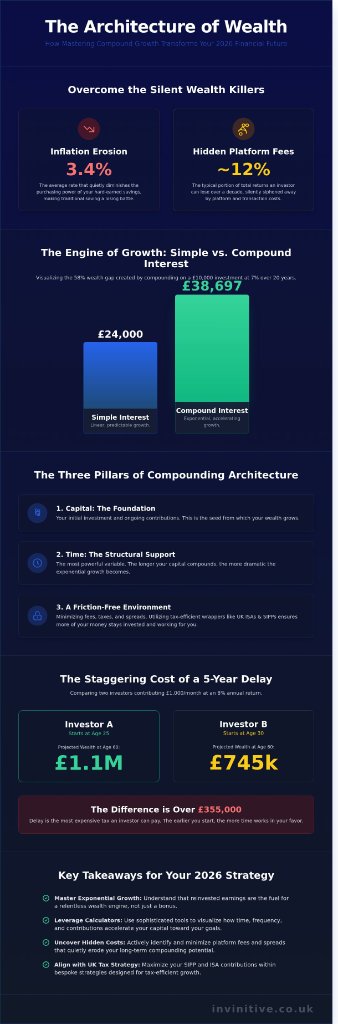
That is why investors should pay attention not just to performance, but also to:
- platform fees
- fund charges
- dealing costs
- foreign exchange charges where relevant
Over short periods these may not look significant. Over decades, they can make a real difference to the final outcome.
How this fits with ISAs and SIPPs
Compound growth becomes even more valuable when combined with tax-efficient wrappers.
A Stocks and Shares ISA can shelter growth and income from UK income tax and capital gains tax, while a SIPP can offer pension tax advantages for long-term retirement saving. For some expats and globally mobile investors, an International SIPP or iSIPP may also form part of that longer-term planning.
That does not guarantee better returns, but it can mean more of the growth stays within the wrapper rather than being reduced by tax.
How to use a compound interest calculator sensibly
A sensible approach is to test a range of assumptions rather than focusing on one best-case figure.
For example, you might compare:
- a cautious return assumption
- a moderate return assumption
- a stronger long-term assumption
You can also compare:
- starting now versus starting later
- increasing contributions
- different fee levels
- different time horizons
This gives a more useful picture than relying on one optimistic number.
Final thoughts
A compound interest calculator is one of the simplest tools for understanding long-term financial growth.
It can help show how starting early, contributing regularly, keeping costs under control, and staying invested for longer may make a significant difference over time.
Whether you are investing through a Stocks and Shares ISA, building retirement savings in a SIPP, or thinking more broadly about long-term wealth planning, the lesson is usually the same: compounding tends to reward patience, consistency and time.
Want to build long-term wealth more efficiently?
Explore how Invinitive can support investing through a Stocks and Shares ISA, SIPP or International SIPP with a modern, flexible approach.
Important Information
Capital at risk. The value of your investments can go down as well as up and you may get back less than you invest. Past performance is not a reliable indicator of future results. This article is for general information only and does not constitute financial advice.