
SIPP Contribution Limits 2026: The Strategic Guide to UK Pension Allowances
Master the 2026/27 SIPP landscape with our expert breakdown of annual allowances, tapering, and carry-forward strategies. This guide answers the most important question for any UK investor: "How much can I actually put into my SIPP in 2026 without triggering a tax charge?" We'll cut through the complexity to give you the clarity and confidence needed to optimise your tax position.
Understanding the 2026 SIPP Landscape: Why Limits Matter
Think of your Self-Invested Personal Pension (SIPP) as your personal toolkit for building a self-directed retirement. It offers incredible flexibility, but to use it effectively, you need to understand the rules of the road. For the 2026/27 tax year, the government has set specific contribution limits, with the core annual allowance remaining at a generous £60,000.
These limits aren't there to hold you back; they exist to create a fair system, balancing the significant tax relief offered to savers with the government's budget. Exceeding them results in a tax charge that cancels out the benefits, so staying within the lines is crucial for smart financial planning.
The Core Philosophy of Pension Tax Relief
At its heart, pension tax relief is simple: the government gives you back the income tax you've already paid on the money you contribute to your pension. This provides an immediate boost to your investment before it even has a chance to grow. For example, a £80 contribution from a basic-rate taxpayer instantly becomes £100 in their SIPP. In 2026, this remains one of the most powerful and efficient tax planning tools available to UK residents.
Who is Eligible for SIPP Contributions?
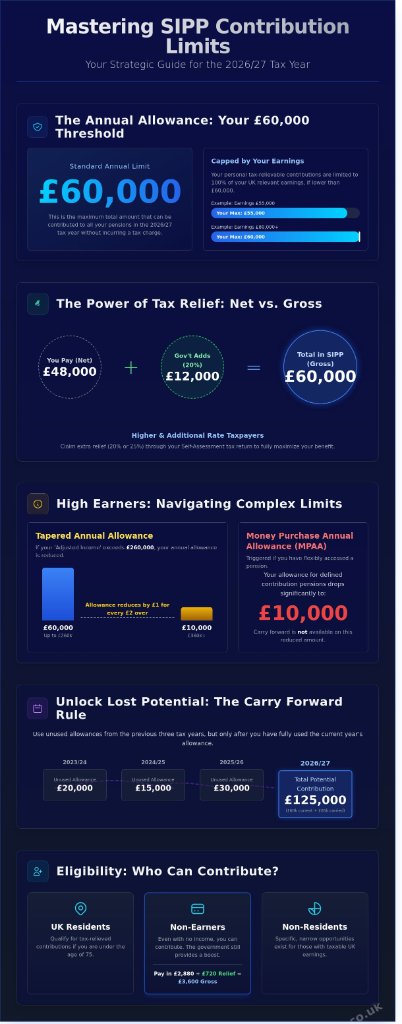
Eligibility is straightforward for most people. If you are a UK resident under the age of 75, you can contribute to a SIPP and receive tax relief. Even if you have no UK earnings, you can still contribute up to £2,880 per year, which becomes £3,600 in your SIPP after basic-rate tax relief is added. There are some specific rules for non-residents with UK taxable income, but for the vast majority, the door to SIPP saving is wide open.
The Annual Allowance: Maximising the £60,000 Threshold
For the 2026/27 tax year, the standard annual allowance is £60,000. This is the maximum amount that can be contributed to all of your pensions combined—not just your SIPP—in a single tax year without incurring a tax charge.
However, there's another rule to remember: your personal contributions are also limited to 100% of your UK relevant earnings for the year. If you earn £45,000, that's the most you can personally contribute. The £60,000 figure is a ceiling that includes everything:
- Your personal contributions.
- Any contributions made by your employer.
- The tax relief added by the government.
This total is known as your "Gross Contribution." A gross contribution is the key figure to track, as it represents the total amount that lands in your pension pot, including the tax relief top-up.
Net vs Gross: The Mathematics of Relief
Understanding the difference between what leaves your bank account (net) and what arrives in your pension (gross) is essential.
- Basic Rate (20%) Relief: When you make a personal contribution, your SIPP provider automatically claims 20% tax relief from HMRC and adds it to your pot. To make a £10,000 gross contribution, you only need to pay in £8,000.
- Higher (40%) and Additional (45%) Rate Relief: If you're a higher or additional rate taxpayer, you can claim back the extra 20% or 25% relief. This is usually done through your annual self-assessment tax return.
Let's look at an example. To get the full £60,000 annual allowance into your SIPP:
- You would personally pay £48,000 (your net contribution).
- Your SIPP provider claims £12,000 in basic-rate relief from HMRC.
- Your total gross contribution is £60,000.
- If you're a 40% taxpayer, you can claim an additional £12,000 back via self-assessment, making the true cost to you just £36,000.
Employer Contributions: The Silent Benefit
Contributions from your employer are a powerful, often overlooked, part of the equation. They count towards your £60,000 annual allowance, but they are paid gross (before tax) and don't reduce your personal taxable income. If your employer offers a salary sacrifice scheme, you can further reduce your National Insurance contributions, making it an incredibly efficient way to save.
High Earners and Complex Limits: Tapering and MPAA
For most people, the £60,000 limit is the main number to watch. However, for high earners or those who have started drawing their pension, two other rules can apply: the Tapered Annual Allowance and the Money Purchase Annual Allowance (MPAA).
The Money Purchase Annual Allowance (MPAA) is a rule that dramatically reduces your allowance to just £10,000 per year once you flexibly access your defined contribution pension savings.
| Allowance Type | Standard Limit | Who It Affects | Key Consideration |
|---|---|---|---|
| Annual Allowance | £60,000 | Most UK pension savers. | The default limit for total contributions from all sources. |
| Tapered Annual Allowance | £10,000 - £60,000 | High earners with 'Adjusted Income' over £260,000. | Your allowance reduces on a sliding scale as income rises. |
| MPAA | £10,000 | Anyone who has flexibly accessed their pension pot. | A permanent reduction that removes the ability to carry forward. |
Navigating the Tapered Annual Allowance
This rule is designed to limit tax relief for the UK's highest earners. It can feel complex, but it boils down to two income definitions:
- Threshold Income: Your total taxable income for the year, before any pension contributions are deducted. If this is below £200,000, tapering does not apply.
- Adjusted Income: Your total taxable income plus all employer pension contributions.
If your Threshold Income is over £200,000 and your Adjusted Income is over £260,000, your annual allowance will be "tapered." For every £2 your Adjusted Income goes over £260,000, your annual allowance reduces by £1. This continues until the allowance hits a minimum of £10,000 for those with an Adjusted Income of £360,000 or more.
The MPAA Trap: Avoiding Restricted Flexibility
The Money Purchase Annual Allowance (MPAA) is a potential pitfall for those approaching or in retirement. It's triggered when you first flexibly access your pension savings, for example, by taking a taxable lump sum.
Once triggered, your annual allowance for contributions to defined contribution schemes like SIPPs drops to just £10,000 per year, and you lose the ability to use the "Carry Forward" rule. This is to prevent people from withdrawing a large sum, receiving tax relief on it again by reinvesting it, and effectively "recycling" tax relief. Be very careful about how you first access your pension to avoid triggering the MPAA unintentionally.
Carry Forward Rules: Unlocking Unused Allowances
What if you have a year with a large bonus, sell a business, or simply want to make a significant contribution that exceeds £60,000? This is where Carry Forward comes in. This valuable rule allows you to use any unused annual allowance from the previous three tax years.
To use Carry Forward, you must have been a member of a registered pension scheme during those previous years. It's a vital strategy for anyone with fluctuating income. The process is logical: you must always use up your current year's allowance first before you can look back and draw upon unused allowances from previous years, starting with the earliest year first.
The Three-Year Lookback Mechanism
For the 2026/27 tax year, you can look back at the allowances you didn't use in:
- 2023/24
- 2024/25
- 2025/26
Keeping accurate records of your past pension contributions is essential to calculate how much unused allowance you have available. By sequencing your contributions correctly, you can make a substantial payment into your SIPP in 2026, far exceeding the standard £60,000 limit.
Step-by-Step Carry Forward Calculation
Let's say you want to contribute £90,000 in the 2026/27 tax year. Here's how you'd calculate if it's possible:
- Step 1: Use the current year's allowance. The first £60,000 of your contribution uses up your full 2026/27 annual allowance. You have an excess of £30,000 to cover.
- Step 2: Look back three years. You check your records for the 2023/24 tax year. Let's say you only contributed £20,000 that year, leaving £40,000 of unused allowance (assuming the limit was £60,000 then).
- Step 3: Apply the unused allowance. You can use £30,000 of the £40,000 unused allowance from 2023/24 to cover your excess. This means your entire £90,000 contribution is made without triggering a tax charge.
- Step 4: Keep records. You now have £10,000 of unused allowance remaining from 2023/24, which you could potentially use in a future year if needed.
Strategic Implementation: Elevating Your 2026 SIPP with Invinitive
Understanding the rules is the first step. The second is choosing a platform built to execute your strategy without friction. An Invinitive SIPP is designed for the self-directed investor who values precision, transparency, and control. We provide the tools; you build the future.
- Execution-Only Administration: A clean, minimalist digital interface that respects your time and intelligence.
- Direct Market Access: Seamlessly execute your investment decisions across a global marketplace.
- Institutional FX Rates: Ensure your global diversification isn't eroded by hidden currency conversion fees.
Commission-Free Growth
At Invinitive, we believe your contributions should go directly into the market, not be chipped away by fees. We remove the friction of spreads and transaction commissions, allowing more of your capital to work for you from day one. Our transparent fee structure is built for long-term wealth preservation and growth.
The Future of Pension Administration
We provide institutional-grade tools for the modern retail investor. For financial advisers, our dedicated portal offers seamless integration and client management. With Invinitive, you are positioning your retirement pot for a future of limitless digital evolution.
Frequently Asked Questions
What is the maximum SIPP contribution for the 2026/27 tax year?
The standard maximum is the lower of £60,000 or 100% of your UK relevant earnings. However, this can be increased by using the Carry Forward rule or decreased for high earners by the Tapered Annual Allowance or for those accessing their pension by the MPAA.
How does the tapered annual allowance work for high earners in 2026?
If your 'Adjusted Income' is over £260,000 and 'Threshold Income' is over £200,000, your £60,000 annual allowance will be reduced. It decreases by £1 for every £2 of adjusted income over £260,000, down to a minimum of £10,000.
Can I carry forward unused SIPP allowances from previous years?
Yes. You can carry forward any unused annual allowance from the three previous tax years (2023/24, 2024/25, and 2025/26 for the 2026/27 tax year). You must use your current year's allowance first.
What happens if I contribute more than my allowance to my SIPP?
If you contribute more than your available annual allowance (including any carried forward allowance), you will face an annual allowance charge. The excess contribution is added to your income for the year and taxed at your marginal rate of income tax, effectively removing the tax relief.
Do employer contributions count towards my SIPP allowance?
Yes. The £60,000 annual allowance is a total limit for all contributions made to your pensions in a tax year, including those from your employer, your personal contributions, and the government's tax relief.
Is there a lifetime limit on how much I can save in my pension?
The Lifetime Allowance was abolished in April 2024. However, it was replaced by new rules on the maximum tax-free lump sums you can take from your pension, including the Lump Sum Allowance (LSA) set at £268,275 for most people.
How much can I contribute to a SIPP if I have no taxable income?
Even with zero earnings, you can contribute up to £2,880 into a SIPP. This will be topped up by 20% tax relief to a gross contribution of £3,600.
What is the Money Purchase Annual Allowance (MPAA) and when does it apply?
The MPAA is a reduced annual allowance of £10,000. It applies once you start to take money from your defined contribution pension flexibly, for instance by taking a taxable lump sum. Once triggered, it's a permanent change and you lose the ability to carry forward unused allowances.