
What Is an ETF? A Simple Guide to Exchange-Traded Funds in 2026
If you are new to investing, one of the first terms you are likely to come across is ETF.
ETF stands for exchange-traded fund. In simple terms, it is a fund that you can buy and sell on a stock exchange, much like a share. Instead of buying one individual company, an ETF usually gives you exposure to a wider basket of investments.
That means a single ETF might hold hundreds of companies, a group of bonds, or investments linked to a particular region, sector or theme.
For many investors, ETFs have become a popular way to build a diversified portfolio in a simple and cost-effective way.
What does an ETF do?
An ETF pools money from many investors and uses it to invest in a collection of assets. For example, an ETF may track:
- a major stock market index such as the FTSE 100 or S&P 500
- a region such as the UK, US, Europe or emerging markets
- a sector such as technology, healthcare or energy
- a type of asset such as bonds, property securities or commodities
Rather than choosing individual shares one by one, an investor can buy one ETF and gain exposure to a whole market or theme.
Why are ETFs popular?
ETFs are popular because they can combine three things many investors want: diversification, simplicity, and low ongoing costs.
Instead of relying on the performance of one company, your investment is spread across many holdings. That can help reduce the impact of any one investment performing badly, although it does not remove market risk.
Many ETFs are also designed to track an index rather than trying to beat it. This is often called passive investing. Because passive funds are usually simpler to run than actively managed funds, their charges are often lower.
How is an ETF different from a share?
A share represents ownership in a single company. An ETF is different because it usually gives you exposure to a collection of investments. So if you buy shares in one business, your return depends on how that business performs. If you buy an ETF that tracks a broad index, your return depends on how that wider group of investments performs.
That is one reason ETFs are often used as core building blocks in long-term portfolios.
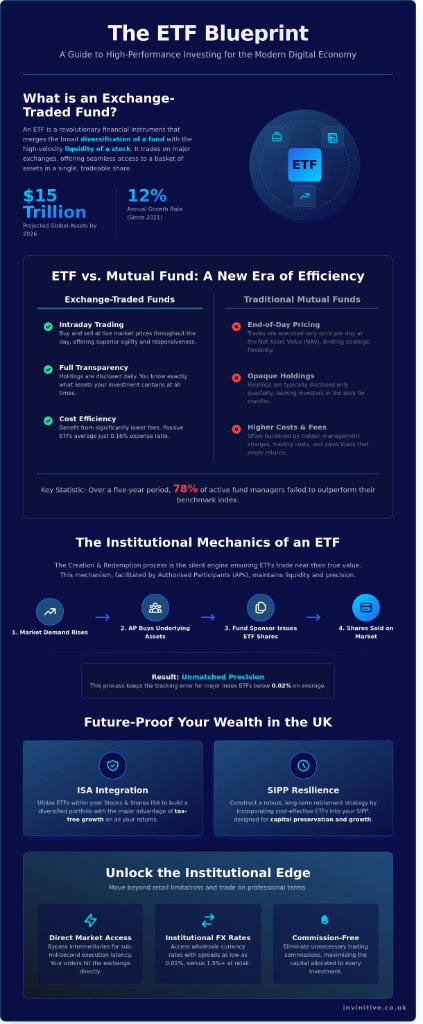
How is an ETF different from a traditional fund?
ETFs and traditional funds are both pooled investments, but they do not work in exactly the same way. One of the main differences is how they trade.
- An ETF is bought and sold on an exchange during market hours, so its price moves throughout the day.
- A traditional mutual fund or OEIC is normally priced once a day, and deals are usually carried out at that valuation point rather than continuously through the trading session.
That does not automatically make one better than the other. It simply means the structure is different, and some investors prefer the flexibility and visibility that ETFs can offer.
What are the main benefits of ETFs?
1. Diversification
One ETF can give you exposure to many holdings. That can make it easier to spread risk than building a portfolio from a small number of individual shares.
2. Ease of use
ETFs are straightforward to buy and sell through an investment platform, and they can be a simple way to access markets that might otherwise be harder to invest in directly.
3. Lower ongoing costs
Many ETFs are relatively low-cost, especially passive index-tracking ETFs. Charges vary, so it is still important to compare products carefully.
4. Transparency
Many ETFs clearly set out what they invest in, what index they follow, and what their annual charge is. That can make them easier to understand than some more complex investment products.
5. Flexibility
ETFs can be held in different account types, including a Stocks and Shares ISA, a SIPP, or a general investment account, depending on the product and platform.
What are the risks of ETFs?
ETFs are not risk-free. The value of an ETF can fall as well as rise, and you may get back less than you invest. The risks depend on what the ETF holds. For example:
- an equity ETF will rise and fall with stock markets
- a bond ETF can be affected by interest rate movements and credit risk
- a specialist or thematic ETF may be more volatile than a broad market tracker
- an overseas ETF may be affected by currency movements
- some complex exchange-traded products may carry additional risks beyond a standard ETF structure
That is why it is important to look not just at the label "ETF", but at what the fund actually invests in and how it fits your wider investment strategy.
Passive ETFs and active ETFs
Many ETFs are passive, meaning they aim to track an index rather than trying to outperform it. For example, a passive global equity ETF might aim to mirror the performance of a global stock market index.
There are also active ETFs, where a manager makes investment decisions within the ETF structure rather than simply tracking an index. Passive ETFs are often chosen for broad market exposure and lower charges, while active ETFs may appeal to investors looking for a more hands-on investment approach.
Income or accumulation: what is the difference?
When you choose an ETF, you may also see the terms income and accumulation.
- An income ETF pays out income, such as dividends or interest, to the investor.
- An accumulation ETF reinvests that income back into the fund.
Neither is automatically better. It depends on whether you want an income stream now or whether you would prefer income to stay invested for long-term growth.
Can you hold ETFs in an ISA or SIPP?
In many cases, yes. Eligible ETFs can often be held within a Stocks and Shares ISA or SIPP, which can make them attractive for long-term investing because of the available tax advantages of those wrappers. ISA rules continue to allow an overall annual subscription limit of £20,000 for 2026/27.
The exact range of ETFs available will depend on the platform and the type of account. It is also worth checking whether the ETF is suitable for UK retail investors and whether there are any product-specific restrictions.
What costs should you look at when buying ETFs?
When comparing ETFs, investors should look beyond just the fund name. Important costs may include:
- the ETF's ongoing charge
- dealing charges on your platform
- foreign exchange charges where relevant
- the bid/offer spread
- any platform or custody fees
A low-cost ETF can still become more expensive overall if the platform charges are high or if foreign exchange costs apply regularly.
Are ETFs good for beginners?
They can be, particularly where an investor wants a simple way to build diversified exposure. For example, a broad market ETF can offer access to a large number of companies through a single investment. That can be easier to understand and manage than trying to build a portfolio share by share from scratch.
That said, "simple" does not mean "risk-free". Beginners still need to understand what the ETF invests in, how much it costs, and whether it matches their time horizon and attitude to risk.
How some investors use ETFs in practice
ETFs are often used in one of three ways:
- as a core holding for broad market exposure
- as a way to add specific themes or sectors
- as part of a wider portfolio alongside shares, funds and cash
For example, an investor might use one global equity ETF as a core long-term holding, then add smaller positions in bond ETFs or sector ETFs depending on their objectives.
Why ETFs matter in long-term investing
For many long-term investors, ETFs are useful because they offer a practical way to stay diversified, keep costs under control, and maintain a disciplined investment approach. They are not the answer to every investment need, and they are not always the right choice in every situation. But for many people, they can be an efficient and flexible way to build a portfolio over time.
How ETFs can fit on the Invinitive platform
At Invinitive, ETFs can form part of a wider investment strategy across different wrappers, including ISAs, SIPPs and general investment accounts, subject to product and investment eligibility. Clients often use ETFs because they can offer straightforward access to broad markets, sectors and investment themes without the need to select every underlying holding individually. The right choice will always depend on the investor's goals, time horizon, and approach to risk.
Final thoughts
If you have been asking "what is an ETF?", the simplest answer is this: it is a fund that trades on an exchange and usually gives you access to a basket of investments through a single purchase.
For many investors, ETFs offer a practical combination of diversification, flexibility and relatively low ongoing costs. They can be a useful tool inside a long-term investment strategy, particularly when used within tax-efficient wrappers such as a Stocks and Shares ISA or SIPP where appropriate.
As with any investment, the key is not just understanding the label, but understanding what sits underneath it.
Frequently Asked Questions
What does ETF stand for?
ETF stands for exchange-traded fund.
Is an ETF the same as a share?
No. A share is an investment in one company, while an ETF usually gives exposure to a basket of investments.
Are ETFs low risk?
Not necessarily. Some ETFs are broadly diversified and relatively straightforward, but all investments can fall as well as rise. Risk depends on what the ETF invests in.
Can I hold ETFs in a Stocks and Shares ISA?
In many cases, yes, provided the ETF is eligible and available on your chosen platform.
Can I hold ETFs in a SIPP?
Yes, many investors use ETFs within SIPPs as part of a long-term retirement strategy, subject to platform and investment availability.
Do ETFs pay income?
Some do. Income ETFs pay distributions out, while accumulation ETFs reinvest income back into the fund.
Are ETFs cheaper than traditional funds?
They can be, especially where they track an index and have low ongoing charges, but total cost depends on the ETF, the platform, dealing fees and any foreign exchange charges.
Are ETFs suitable for beginners?
They can be, particularly diversified broad-market ETFs, but investors still need to understand the product, the risks and the costs.
Want to invest in ETFs through an ISA, SIPP or GIA?
Explore the Invinitive platform and see how ETFs can fit into your wider investment strategy.
Important Information
Important information: The value of investments can go down as well as up, and you may get back less than you invest. Tax rules depend on individual circumstances and may change in future. This guide is for general information only and does not constitute personal financial advice or a recommendation.