
Understanding the Invinitive SIPP
A comprehensive guide to how a Self-Invested Personal Pension works, how the Invinitive SIPP operates, and the key points to understand before opening or transferring.
For general information only. Not financial advice.
Introduction

If you are reading this guide, there is a good chance you already know a little about pensions, but you may not be fully clear on what a SIPP is, how it works, or how it differs from other types of pension.
That is completely normal. Many people have heard the term SIPP before, but are not quite sure what sits behind it. Some think it is just another investment account. Some assume it is only for experts. Others believe it is always better than a workplace pension. None of those ideas gives the full picture.
A SIPP is a type of personal pension. It sits within the wider UK pension system and follows pension rules. What makes it different is that it often gives the account holder more control, more visibility and a wider range of investment choices than some other pension arrangements.
This guide has been written to explain the subject clearly and in plain English. It is designed to help you understand:
- what a pension is
- what a SIPP is
- how a SIPP differs from other pension arrangements
- how the Invinitive SIPP works
- what "execution-only" means in practice
- what charges, risks and transfer processes people should understand
- what happens later when pension benefits are accessed
- what Invinitive can and cannot help with
The purpose of this guide is not to tell you what you should do. Instead, its purpose is to help you understand the product and the subject well enough to ask better questions, read the product documents more confidently and decide whether you want to explore the product further or take independent advice.
The Invinitive SIPP is an execution-only product. This means Invinitive can explain the product, its features, charges and administrative process on a factual basis, but does not provide financial advice, tax advice, a personal recommendation or a suitability assessment. In other words, this guide is here to explain, not to advise.
You can think of this guide as a map. It is here to show you the landscape, explain the main terms, and help you understand how the product works. It is not here to choose the route for you.
What is a pension?
In very simple terms, a pension is a long-term savings arrangement designed to help provide money later in life, usually when someone stops working or works less.
You can think of a pension as a retirement pot with rules. It is a pot because money and investments can build up inside it over time. It has rules because it is designed for later life, not everyday spending; it has special tax treatment under pension rules; and there are legal rules around when benefits can normally be taken.
A pension is not the same as an ordinary savings account or a normal investment account. It is not designed to be money you can take out whenever you want. Pensions are built for the long term.
Why pensions exist
Most people will need some form of income later in life. A pension is one of the main ways people build money for later life over many years. Because pensions are designed for retirement saving, the government gives them a special legal and tax framework to encourage long-term saving.
Different types of pension
Some people have workplace pensions through their employer. Some have personal pensions. Some may have defined benefit pensions, sometimes called final salary pensions. Others may have defined contribution pensions, where the value depends on the money paid in and how the investments perform. A SIPP sits within this wider pension world — it is one type of pension arrangement.
A pension is a long-term retirement arrangement with rules. It is designed to help people build money for later life. Because of that, it is treated differently from ordinary savings and ordinary investment accounts. That foundation makes it much easier to understand what a SIPP is and why it works the way it does.

What is a SIPP?
SIPP stands for Self-Invested Personal Pension. That may sound technical at first, but it becomes much easier once you break it into parts.
In plain English, a SIPP is a type of personal pension that usually gives the account holder more control over how their pension money is invested. A SIPP is still a pension first, but it is a pension that often allows a wider choice of investments and a more direct role for the person holding it.
The "wrapper" idea
One of the easiest ways to understand a SIPP is to think of it as a wrapper — a container with rules around it. Inside the wrapper, investments can be held. Around the wrapper sit pension rules, tax rules, product rules and access rules. The SIPP is the home. The investments are what sit inside the home.
More freedom, but also more responsibility
A SIPP can offer more control than some simpler pension arrangements. But more control does not mean less responsibility. In fact, it usually means more. If someone wants a wider choice of investments, greater visibility and more direct involvement, they also need to accept that investment choices matter, risks still exist, decisions can affect long-term outcomes, and the provider may not tell them what they should do. That last point is especially important in an execution-only arrangement.
A SIPP is still a pension — it is designed for retirement saving, sits inside pension law and pension tax rules, and access to benefits is generally restricted until the minimum pension age set by legislation. A SIPP is not automatically better than another type of pension. It is simply a different type — often designed for people who want to be more directly involved.

Why do SIPPs exist?
Not everyone wants the same kind of pension. Some people are happy in a workplace pension with a smaller investment menu and very little need to make decisions. Others want something more flexible — more control over their pension, a clearer view of what they hold, a broader range of investment options, a personal pension structure rather than relying only on an employer scheme, and the ability to transfer eligible old pension arrangements into one place.
A SIPP exists to meet that type of need. It gives people a pension structure that is often more flexible and more investment-led than some simpler pension arrangements, while still sitting within the UK pension system.
More control means more responsibility
A SIPP may offer more freedom and more flexibility, but that also means more responsibility — more decision-making, more need to understand investment risk, more need to understand the product properly, and more need to recognise when independent advice may be needed. This is especially important in an execution-only product, where the provider explains the product and process but does not make decisions for the client.
SIPPs exist for people who want to be more involved in their pension. They do not just want a pension that sits in the background. They want one they can understand, manage more directly and monitor more closely. But more flexibility does not remove the need to understand the product carefully. In many ways, it makes that understanding even more important.

How is a SIPP different from other pension arrangements?
Many people already have pensions before they ever look at a SIPP — a workplace pension, an older personal pension, a pension from a previous job, a defined benefit pension, or more than one pension built up over time. A SIPP sits within that wider pension world. To understand a SIPP properly, it helps to compare it with the main alternatives.
A SIPP and a workplace pension
A workplace pension is usually set up through an employer, with a limited investment menu. Many members stay in the default investment option without making active choices. A workplace pension is often designed to be straightforward and easy to operate for a large number of employees. A SIPP is usually a personal pension that is more self-directed, more choice-led, more visible to the account holder, and more likely to require active decisions. A workplace pension is often more "set up for you." A SIPP is often more "run by you."

A SIPP and a defined contribution pension
A lot of pensions today are defined contribution pensions, meaning the value depends on contributions, transfers, investment growth or loss, charges, and withdrawals. A SIPP is usually a form of defined contribution pension. What makes it stand out is not that it is defined contribution, but that it is often more flexible and more self-directed than some other defined contribution arrangements.

A SIPP and a defined benefit pension
A defined benefit (final salary) pension is very different from a SIPP. A SIPP is usually based on a pot of money whose value depends on contributions, investment performance, charges and withdrawals. A defined benefit pension is usually based on a promise of benefits under scheme rules, which may depend on things like salary and years of service, rather than simply on the value of an investment pot. That is why defined benefit transfers are treated as such a serious area. They are not just about moving money from one pot to another. They may involve giving up valuable guarantees or benefits, which is why they require particular care and, in some cases, regulated advice.

A SIPP and an ISA
Both can hold investments, but they are not the same thing. A SIPP is a pension designed for retirement saving, follows pension rules, and normally cannot be accessed freely until the relevant pension access age. An ISA is not a pension, has its own separate rules, is usually more accessible, and does not function as a retirement-specific pension wrapper. Both can hold investments and be used for long-term planning — but they are built for different purposes and sit under different rules.

A SIPP is one kind of pension arrangement. It often gives the account holder more control, more visibility and a broader investment framework than some other pensions, but it does not replace the need to understand what type of pension is being compared and what may be given up or gained in the process. Understanding the differences is one of the best ways to avoid confusion.
What does "self-invested" really mean?
The words self-invested can sound more complicated than they need to. Some people hear them and immediately wonder: "Do I have to be an expert investor? Does this mean I pick everything myself? Is it only for people who know the markets inside out?"
When a pension is described as self-invested, it usually means the person holding the pension has a more direct role in deciding how the pension money is invested. Instead of being placed into a small, pre-set range of options with very little involvement, the account holder usually has broader choice and more responsibility for decisions. That does not mean unlimited choice. It does not mean there are no rules. It does not mean risk disappears.
More choice usually means more responsibility
People are often attracted to the word choice. That is understandable. But with pensions and investments, more choice usually comes with more responsibility — more decisions to make, more need to understand investments and risk, and more need to recognise when advice may be required. That is one reason why self-invested pensions are often linked to people who are comfortable being more involved in financial decisions, or who are working with their own adviser.

The role of the product provider
A provider still has an important role — operating the pension wrapper, managing administration, applying product rules, explaining charges, processing transfers where relevant, and providing access to the product and its functionality. But in an execution-only structure, the provider does not take over the decision-making role of an adviser. There is a difference between giving factual information about the product and process, and advising someone on what they should do. The first is part of the provider's role. The second is not.
"Self-invested" means the account holder usually has more choice and more involvement in how the pension is invested. It does not mean there are no rules, there is no risk, or that the provider tells the client what to do.
Who is this type of product generally designed for?

Once someone understands what a SIPP is, how it differs from other pensions, what "self-invested" means and what "execution-only" means, the next sensible question is: Who is this type of product generally designed for?
A SIPP usually makes most sense for people who want a personal pension structure, more visibility, more direct involvement, and who understand that pensions are long term and investment-based. They should be comfortable with investment risk and understand the limits of execution-only.
Who might need extra caution
This type of product may not naturally suit someone who wants the provider to tell them what they should do, does not feel comfortable making financial decisions, does not understand investment risk, wants short-term access to the money, or needs tax advice before making decisions.
- Someone with a defined benefit / final salary pension — valuable guarantees may be at stake
- Someone unsure whether to transfer — that may be an advice question, not just a product question
- Someone uncertain about tax consequences — personal advice may be needed
- Someone who wants the provider to make the decision — that is not how an execution-only product works
The Invinitive SIPP is generally designed for individuals who want a UK personal pension wrapper, online visibility and administration, access to a broad range of standard investments, and a clear execution-only structure. It is not designed as an advised service.
Opening an account

When people talk about "opening a SIPP," they are really talking about setting up the pension structure in the correct way. A SIPP is not just an online account — it is a pension arrangement, which means it must be established properly from the start. That is why opening an account usually involves more than just entering an email address and choosing a password.
The purpose of the account opening process is to: identify the person applying, establish the pension in the correct name, collect the information needed to operate the product properly, provide the product terms and disclosures, and complete the checks needed before the arrangement can be used.
Why information has to be collected
A SIPP is a regulated financial product. The provider needs enough information to verify identity, meet legal and regulatory obligations, set the product up correctly, and process future administration accurately. That is why the application process may ask for full name, date of birth, address details, contact information, tax residency or nationality details where relevant, and information about whether a transfer or contribution is expected.
Identity verification is a normal part of the setup process. More information may sometimes be needed where someone lives overseas, documents do not match perfectly, or further clarification is required for legal or regulatory reasons. This does not necessarily mean there is a problem — it often just means the provider needs to complete the setup properly.
Product terms and disclosures matter
Opening a SIPP should not feel like clicking through a process without understanding what sits behind it. The product documents explain what the product is, how it operates, what it allows, what it does not allow, what costs may apply, and what responsibilities remain with the client. In a good account opening process, the provider gathers the information it needs, and the client gets the information they need.
Completing an application does not mean advice has been given. Opening the Invinitive SIPP does not mean financial advice has been given. The product is provided on an execution-only basis, which means the decision to proceed remains with the client.
Ready to take the next step?
Book a product information call to ask factual questions, or open your SIPP when you're ready.
Making contributions

Once a SIPP has been opened, the next practical question is often: How does money actually get into the pension? That is where contributions come in. A contribution is money paid into the pension so it can be held within the pension wrapper and, where applicable, invested for the long term.
A contribution is new money going in. A transfer is pension money moving across from somewhere else. A contribution may be paid personally by the account holder, by an employer (where relevant), on a regular basis, or as a one-off amount. Once money is paid into the pension, it becomes part of the SIPP — it is not money sitting outside the pension.
Why contributions matter
A pension does not usually build itself. For most people, pension value grows over time because contributions are made, transfers come in from other pensions, investments grow over time, and money remains invested for the long term. Contributions are one of the main ways a pension starts growing or keeps growing.

Personal and employer contributions
A personal contribution is money paid in by the individual — whether as regular monthly contributions, occasional one-off amounts, or a mixture of both. In some cases, contributions may also come from an employer, where an employer is using the pension as part of retirement provision for an employee or director. The detailed tax treatment and allowance position can become more complex in those cases, which is why personal advice may be needed where certainty is required.
Contributions are still subject to rules
You cannot think about contributions properly without remembering that pensions have rules around how contributions work — including contribution limits and tax relief rules. The next sections explain this in more detail. A pension is not designed for short-term use. It is meant to build up value over time for later life, which means a contribution should not be thought of as a quick-access deposit.
Pension contributions are subject to rules, and tax treatment depends on individual circumstances. If you need advice on how much to contribute or what the personal tax outcome may be, you should take independent advice.
Tax relief explained simply
One of the reasons pensions are so widely used for long-term planning is that they usually come with special tax treatment. That does not mean pensions are tax-free in every way, and it does not mean the rules are the same for everyone. But it does mean pensions are treated differently from ordinary savings accounts and ordinary investment accounts.
What is tax relief?
In plain English, tax relief means the government gives pensions special tax treatment to encourage people to save for retirement. If someone puts money into a pension, the rules may allow that contribution to be boosted in line with pension tax rules. This is one of the reasons pensions are often seen as long-term savings tools rather than ordinary accounts.

The simplest way to picture it
Imagine two people each have money they want to set aside for the future. One puts money into an ordinary savings account. The other puts money into a pension. The savings account may be easier to access, but it does not sit inside pension tax rules. The pension is more restricted, but it may benefit from tax relief and other pension tax treatment. That is part of the trade-off.

Tax relief is helpful, but it is not the whole story
It is easy for people to focus only on the attractive side of tax relief and forget the wider picture. A pension is still a long-term product, subject to access restrictions, contribution rules, investment risk, and future tax rules when benefits are taken. So tax relief should be understood as one part of the pension picture, not the whole reason to use one.

Tax treatment depends on individual circumstances and may change in future. This guide explains tax relief in general terms only and does not provide personal tax advice.
Annual allowance explained simply
Once people hear that pensions can benefit from tax relief, the next question is often: Is there a limit to how much can go in? The short answer is yes, pensions have contribution rules. One of the main ideas behind those rules is something called the annual allowance.
What is the annual allowance?
In simple terms, the annual allowance is a limit used within pension tax rules. It helps decide how much pension saving can usually receive tax-advantaged treatment in a tax year, based on the rules that apply at the time. It is better to think of it as part of the tax framework around pension saving rather than a simple payment cap.

The government gives pensions special tax treatment because they are meant for long-term retirement saving. But that tax treatment is not intended to be completely unlimited. The annual allowance exists to put structure around pension saving within the tax system — to help draw a line around how much pension saving can normally benefit from pension tax advantages in a given tax year.
The annual allowance is not just about personal contributions. Depending on the situation, pension saving may also involve employer contributions and pension growth measured in different ways under different arrangements. That is why the annual allowance should be seen as part of the wider pension tax rules, not just a simple limit on one kind of payment.
Annual allowance and tax relief are linked
The annual allowance sits closely alongside tax relief. Tax relief explains why pensions may receive favourable treatment. The annual allowance helps define the limits of that support within a tax year. The two ideas work together: tax relief explains why pensions may receive favourable treatment, and the annual allowance helps explain the normal limits around that treatment.

The annual allowance is measured by reference to a tax year, not just by looking at pension saving in a vague long-term way. That means pension activity is looked at within a yearly framework. Someone making larger or more complex contributions may need proper advice or tax support.
The annual allowance is one of the main rules that helps set the normal yearly limits for tax-advantaged pension saving. It sits alongside tax relief as part of the wider pension tax framework. You do not need to know every detail straight away, but you do need to understand that pension contributions are supported by the tax system and also controlled by it.
Investment options explained simply
Once a SIPP has been opened and funded, the next big question is often: What can actually be held inside it? This is one of the main reasons people become interested in SIPPs in the first place — a SIPP is often associated with broader investment choice than some simpler pension arrangements.
But a SIPP is still a pension — not an account with unlimited freedom. What can be held inside it depends on the provider's product terms, operating model, permitted asset rules and regulatory framework. A SIPP is the pension structure; the investments are what sit inside that structure.
Standard investments and permitted assets
In general terms, when people talk about SIPPs they are often thinking about access to mainstream investment categories such as shares, funds, exchange traded products, investment trusts, bonds, and cash holdings within the pension. The exact range available always depends on the provider's own product structure and rules. For the Invinitive SIPP, investment access is subject to product terms, permitted asset rules and operational requirements.
Not everything inside a SIPP has to be invested at every moment. A SIPP may hold cash as well as investments — for example, when a contribution has recently been received, when a transfer has completed in cash, when investments have been sold, or when future transactions are expected.
Broader choice does not mean simpler decisions
More investment choice can be useful, but it does not automatically make decisions easier. In fact, broader choice can create more questions: What should be held? How much risk is appropriate? How diversified should the pension be? How often should changes be made? That is why investment choice should be understood alongside investment responsibility.

The Invinitive SIPP is provided on an execution-only basis. Invinitive can explain the product and its investment framework in general terms, but does not recommend investments or assess suitability. A SIPP can provide access to a broader range of standard investments than some simpler pension arrangements, but that broader choice still sits within product rules and still leaves decisions with the client or their adviser.
Investment risk explained simply
Investment choice is one of the main features people associate with a SIPP. But investment choice and investment risk always go together. In plain English, investment risk means the value of an investment can change — sometimes it may rise, sometimes it may fall, sometimes it may move sharply in a short period.
A SIPP is not a savings account with a fixed return. It is a pension wrapper that can hold investments, and investments do not move in a straight line.
The simplest way to think about it
Risk is the price of uncertainty. If money is invested, the outcome is not guaranteed. The investment may do well, it may do badly, it may behave differently from what the investor expected. That does not make investing wrong. It simply means uncertainty is part of investing.

Why risk matters in a SIPP
Investments can go up or down based on market, economic, or geopolitical conditions, or the investments held inside the SIPP. That means the account holder needs to understand that the value of the pension can go down as well as up, that different investments carry different risks, that decisions made inside the SIPP can affect long-term retirement outcomes, and that the provider is not making personal investment decisions for them.
Risk cannot be removed completely
With an investment-based pension, risk may be reduced, managed, spread or understood better, but it is not something that can always be removed completely if money is invested. Broader investment choice does not create a risk-free environment. One of the ideas people often come across when learning about investing is diversification — not putting everything in one place or relying on one single investment. The basic idea is that spreading exposure may reduce the effect of one investment performing badly.
The Invinitive SIPP is an execution-only product. Invinitive can explain the product and process, but does not recommend investments or assess whether a particular investment approach is suitable for you.
Charges explained
A quick overview of how SIPPs charge
SIPP charges can look simple at first, but in practice they are often made up of several separate layers. Depending on the provider, you may see charges for the pension wrapper itself, the platform or administration, custody or dealing, foreign exchange, adviser servicing, and underlying fund or investment costs.
This is why comparing SIPPs is not always straightforward. One provider may look cheap on the headline fee, but more expensive once trading, FX, wrapper fees or adviser costs are added. The most important thing is not just the label on the fee, but the total cost of ownership.
Invinitive charges
The Invinitive SIPP is designed to be clear and transparent. Our core charging structure is straightforward:
- 0.25% platform fee per year, capped at £400
- £150 annual SIPP fee (waived for accounts below £50,000)
- £7.95 per trade
- Transparent FX pricing
- No spreads or commissions applied on UK and US trades, and no interest retention
This matters because many investors do not just want a low price — they want to understand exactly what they are paying, who is being paid, and whether charges are being added in different places across the structure. At Invinitive, the aim is to keep the structure simple, visible and fair. Smaller accounts are not overburdened, and larger accounts benefit from the platform fee cap.
It is also worth remembering that paying less in charges compounds over the long term. Every pound saved in annual fees remains invested, has the potential to grow, and can make a meaningful difference to the eventual value of a pension over a decade or more.

How other SIPP charging models may work
Not all SIPPs are built in the same way. Some charge a visible wrapper fee plus dealing or platform costs. Others can be more fragmented — in some international arrangements, the pension may sit with one entity while a separate investment company or bond provider holds the underlying investments, creating multiple cost layers including trustee or administration fees, investment bond charges, fund costs, dealing costs, adviser remuneration, and establishment or exit charges.
This does not automatically make the structure bad, but the layering can make it harder for clients to see the full picture.
Lifebonds in the international market
In the international advice world, many advisers have historically recommended offshore life bonds or similar investment bond structures alongside pension planning. Used properly, these structures can sometimes be operated at a moderate cost. However, the issue is often not just the product — it is how the product is used. In less transparent arrangements, advisers may build in significant upfront or ongoing remuneration, sometimes reaching up to 7% upfront, presented as though it were simply part of the product cost rather than adviser remuneration.
A product charge is one thing. An adviser's commission hidden inside a structure is another.
Why transparency matters
Clients should always ask: What is the platform or wrapper fee? Are there separate trustee charges? Is there adviser remuneration built in? Are there exit fees or surrender penalties? What is the total cost each year? A low-looking headline number can be misleading if the real cost is spread across multiple providers, product layers or adviser remuneration arrangements.
SIPP charging should not be judged on one fee in isolation. The real question is: what is the total cost, how transparent is it, and who is being paid? Invinitive's approach is to keep that answer clear — a simple, visible and competitively priced structure, without the layered and often opaque charging models that can still be found elsewhere in the international market.
How pension transfers work
For many people, one of the main reasons to look at a SIPP is the possibility of moving an existing pension into it. That is called a pension transfer. A pension transfer is both a financial movement and an administrative process. People sometimes imagine it works like moving money from one bank account to another — in reality, it is usually more involved than that.
A pension transfer is a process, not just a payment. A pension transfer usually involves forms, checks, provider communication, identity or verification requirements, product setup at the receiving side, review and processing by the ceding provider, and decisions about whether the transfer is in cash or by asset movement, where available. That is why transfers can take time and should be understood as an administrative journey, not just a transaction.
The basic transfer journey
- The receiving product is in place — the SIPP is opened and the receiving structure is established
- Transfer paperwork is completed — forms and supporting information are provided so the transfer request can be progressed
- Checks are carried out — the receiving provider reviews the paperwork and carries out the checks needed
- The ceding provider processes the request — the existing provider applies its own rules, internal process and timescales
- Cash or eligible assets move — the transfer completes in the form accepted and available under the circumstances
- The value is received into the SIPP — once received, the cash or assets are reflected within the pension wrapper

Cash transfer or asset transfer
Not all transfers happen in the same way. Some transfers are completed by moving cash — holdings are sold with the ceding provider and the proceeds are transferred across. Some transfers may involve re-registration of eligible assets, where this is available and accepted by all relevant parties. The route used can depend on the type of investments held, operational compatibility, and the processes of the providers involved.
A pension transfer means moving pension value from one arrangement to another. It often involves forms, checks and provider processes, so it can take time. The Invinitive SIPP is provided on an execution-only basis. Invinitive can explain the transfer process, but does not advise on whether a transfer is suitable or whether valuable benefits should be given up.
A defined benefit pension transfer is very different from an ordinary pot-to-pot transfer. Moving from a defined benefit pension may involve giving up valuable guarantees or promised benefits. In some circumstances, regulated advice is required before a transfer can proceed.
Why transfers can take time
One of the most common questions people ask about pension transfers is: Why is this taking so long? That is a fair question. From the outside, a transfer can sound simple. In reality, pension transfers often take longer than people expect because they are not just money movements — they are multi-step administrative processes involving rules, checks, documentation and more than one party.
Transfers can take time because more than one party is involved, and the existing provider often controls key parts of the timing. Even if the receiving SIPP is ready and the client has completed everything requested, the transfer may still depend heavily on how quickly the ceding provider works through its own process.

A transfer is not one action
A transfer is usually a chain of stages: opening the receiving account, gathering the right forms, checking the details, submitting the request, waiting for the ceding provider to review it, dealing with any questions or missing information, selling holdings if a cash transfer is needed, moving money or eligible assets, and receiving and processing the transfer at the new end. If any one of those stages takes longer than expected, the overall transfer takes longer.
A transfer can only move as fast as the slowest key step. Many people now expect everything to be digital, but in practice some pension providers still require wet signatures for certain documents, which can add time if a client is travelling or living abroad.
The provider sending the money often controls much of the timetable. When pension value is being transferred out of an existing arrangement, the provider holding that value usually controls important parts of the process — confirming the benefits or holdings, reviewing the transfer request, arranging the sale of holdings if required, releasing the cash or assets, and completing its own internal checks.

Delays do not always mean the transfer is failing
A delay does not automatically mean the transfer has gone wrong, the money is lost, the receiving provider has made an error, or the whole process has collapsed. Sometimes a delay simply means that a stage is still being worked through. Transfer times can vary significantly depending on the pension type, the provider involved, the transfer method and whether additional documents or checks are required. Slow does not always mean broken.

Because transfers can take time, communication matters. Clients often feel more comfortable when they understand what stage the transfer is at, what is being waited for, whether action is needed from them, and what the next step is likely to be. A clear explanation does not necessarily make the transfer faster, but it often makes the experience easier to understand.
What can go wrong in a transfer

A pension transfer does not have to be a bad experience to be a complicated one. Even when everyone is acting in good faith, things can still go wrong, slow down or become more difficult than expected. Many transfer problems are smaller and more ordinary than people imagine — missing forms, incorrect form completion, mismatched personal details, signature issues, or delays in selling holdings.
A small paperwork issue can create a big delay. A form may be missing a signature, missing a page, completed in the wrong format, or signed electronically when a wet signature is required. Even small differences can matter if the provider receiving the form applies strict rules. Additionally, the personal details on file with the existing provider may not match the new documentation exactly — differences involving name format, old versus current address, date formatting, or historic account data may need to be resolved before the transfer can proceed.
Some transfer problems are not really "errors" at all — they are simply the result of the ceding provider using its own process. A provider may insist on its own discharge forms, reject a form that looks acceptable to everyone else, require a wet signature, or take longer than expected to respond. A transfer can slow down even when the client has done their part.

Investment-related complications
Transfers can become more difficult where investments are involved — especially if there are many holdings, the holdings need to be sold before transfer, the assets are not eligible for re-registration, or one provider cannot accept a particular holding. Where a transfer is happening in cash, investments may need to be sold before the money can move, which involves sale instructions, dealing times, settlement periods, and reconciliation before release.
Some transfer issues are much more serious than ordinary paperwork delays. If a pension includes safeguarded benefits, guaranteed features, defined benefit rights, or special terms that may be lost on transfer, the case may need much greater care and, in some circumstances, regulated advice before a transfer can proceed. Where a transfer involves guaranteed, safeguarded or defined benefit rights, extra care may be needed and regulated advice may be required in some circumstances before the transfer can proceed.
A client may do everything asked of them and still find that the transfer pauses because the ceding provider is slow, the provider asks for fresh paperwork, internal review is taking time, or benefits need clarification. This can be frustrating, but it does not always mean the client has done anything wrong.

Problems in a pension transfer can arise for many reasons, from small paperwork issues to more serious questions about assets, benefits or provider requirements. Not every problem means the transfer is failing. But every problem does need to be understood clearly, so the next step in the process makes sense.
Safeguarded benefits, transfer advice and why these cases need special care
Some pension transfers are relatively straightforward from a technical point of view. Others are not. One of the most important dividing lines is whether the pension includes safeguarded benefits. This matters because safeguarded benefits can carry valuable guarantees or promises that may be lost if the pension is transferred.
A safeguarded benefit is usually a pension right with a promise attached to it, not just a pot of invested money. In simple terms, safeguarded benefits are pension benefits that give the member some form of promise, guarantee or protected outcome, rather than simply being a normal investment pot whose value rises and falls with the market. This often includes defined benefit / final salary pensions, cash balance benefits, and certain other benefits with guarantees or protected features.
Why safeguarded benefits matter so much
If someone transfers safeguarded benefits into a flexible defined contribution arrangement, they may be giving up things such as a promised level of pension income, inflation-linked increases, spouse or dependant benefits under scheme rules, or other valuable scheme features or guarantees. That is why these transfers are treated very seriously. They are not just administrative moves from one pot to another. They may involve the loss of rights that cannot be recovered once given up.

When advice is legally required
Where safeguarded benefits are worth more than £30,000, the law requires the member to take appropriate independent advice before certain transactions, such as transferring to flexible benefits, can go ahead. This requirement comes from the Pension Schemes Act 2015 framework and related legislation. That does not mean the advice must recommend a transfer — in fact, many cases result in a recommendation not to transfer.
What is an APTA?
If full transfer advice is being given on a safeguarded benefits transfer, the adviser must carry out an Appropriate Pension Transfer Analysis (APTA). This is a structured piece of analysis designed to help the adviser assess whether giving up the safeguarded benefits can be justified for that particular client — looking at the client's objectives, the nature of the benefits being given up, the client's ability to absorb risk, and the likely implications of moving to flexible benefits.
The FCA also allows something called abridged advice, which is a shorter form of transfer advice that can result in a personal recommendation not to transfer, or a statement that the adviser cannot make a recommendation unless the client goes on to full advice.
An APTA is the adviser's detailed analysis of whether giving up safeguarded benefits can be justified for that client.

These cases can easily run to many months and, in practice, around nine months or more once advice, paperwork, provider response times and transfer execution are all taken together. Safeguarded benefits are pension benefits with guarantees or promises attached, such as many final salary pensions. If they are worth more than £30,000 and a transfer is being considered, specialist independent advice is usually required first.
Invinitive does not assist with safeguarded benefits cases and does not provide the specialist transfer advice, APTA or recommendation process required for these transfers. Clients with safeguarded benefits must seek appropriate independent advice elsewhere first.
Taking benefits in future: when and how pension money can usually be accessed
A pension is built for later life. For most people, that means the money stays inside the pension for many years while it grows, changes in value and remains invested. You can usually start taking money from a defined contribution pension from age 55, rising to 57 from 6 April 2028, unless a special rule such as a protected pension age or serious ill-health exception applies.
The three main ways to take money
1. Flexi-access drawdown
Take tax-free cash and leave the rest invested, then draw income or lump sums from the crystallised drawdown pot. Usually allows you to take up to 25% tax-free and leave the rest invested.
2. UFPLS (Uncrystallised Funds Pension Lump Sum)
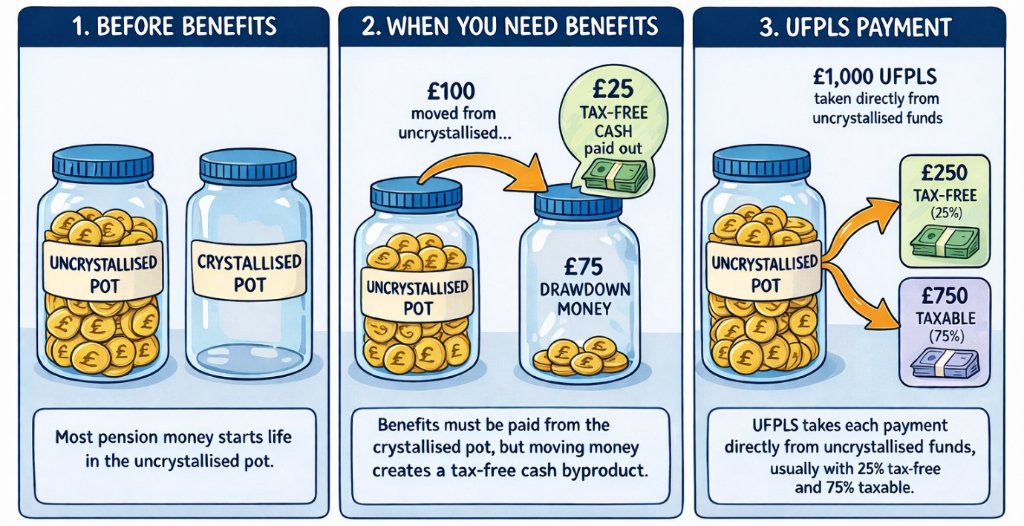
Take lump sums directly from uncrystallised funds without first setting up drawdown. Each payment is usually 25% tax-free and 75% taxable pension income.
3. Annuity
Use some or all of the pension to buy a guaranteed income. You can usually take up to 25% tax-free before buying the annuity. Note: Invinitive does not currently offer annuities — a client wanting an annuity would need to use another provider for that function.
The two jars: a simple way to understand drawdown
Picture a pension as having two jars. Jar 1 (uncrystallised): where pension money usually sits while building up — contributions, transfers and investment growth usually sit here until a benefit event happens. Jar 2 (crystallised): the side linked to money that has already been used for a benefit event — this is where drawdown money sits after benefits have been set up.
When you want to start taking benefits through drawdown, money moves from the uncrystallised jar into the crystallised side. A simple way to picture that move: if £100 is crystallised for drawdown, £75 stays inside the pension as drawdown money, and £25 is normally released as tax-free cash. This is a useful mental model, though in strict pension terms, taking tax-free cash and designating money to drawdown are separate activities and do not have to happen at the same time.
There are usually three main ways to take money from a defined contribution pension: drawdown, UFPLS and annuity. Drawdown and UFPLS are different, even though both can produce tax-free cash and taxable income.
What UFPLS means in simple terms
UFPLS (Uncrystallised Funds Pension Lump Sum) is a way of taking money directly from uncrystallised funds without first setting up drawdown in the same way. If a client wants £1,000 from the pension using UFPLS, the payment is usually split: £250 tax-free and £750 taxable pension income. This means the client can draw money directly from the uncrystallised side each time, rather than first creating a larger crystallised drawdown pot. Both drawdown and UFPLS can pay money out, but the route is different.
The Money Purchase Annual Allowance warning
If someone flexibly accesses taxable money from a defined contribution pension, it can trigger the Money Purchase Annual Allowance (MPAA), which reduces the amount they can usually pay into defined contribution pensions in future while still receiving tax relief. The MPAA is £10,000 a year. Taking only tax-free cash and leaving the rest invested does not usually trigger it. Taking pension income can change the future contribution rules.
A practical note on payment timing after a transfer
Invinitive cannot normally make benefit payments immediately after pension benefits are transferred in from another scheme. The firm needs the crystallisation confirmation from the ceding scheme showing how the transferred benefits were structured at the point of transfer — whether fully uncrystallised, fully crystallised, or partly crystallised. Without that confirmation, there is a real risk of paying the wrong type of benefit. In practical terms, this usually means a short delay of around three to five working days, though with some overseas transfers it may take longer.
From age 55, rising to 57 from 6 April 2028, you can usually start taking money from a defined contribution pension. Taking taxable income or UFPLS can trigger the Money Purchase Annual Allowance, which is usually £10,000 a year. Tax treatment depends on individual circumstances and may change.
What happens to your pension when you die
A pension does not always simply disappear on death. In many cases, money from a defined contribution pension can still be paid to other people, depending on the type of pension, the scheme rules, the member's death-benefit nominations and the tax rules applying at the time.
Your pension may still help other people after you die. A defined contribution pension is usually still an asset with value at death. That value may be able to pass to a spouse or civil partner, children, other family members, or another nominated person, or in some cases a trust or estate-related route depending on the scheme rules.
Why nominations matter
A nomination (sometimes called an expression of wish) is the member's way of telling the pension provider who they would like to receive the death benefits if they die. It can also make the process clearer and smoother for the people left behind. A nomination is important to keep updated, especially after life events such as marriage, divorce, children being born, bereavement, or major relationship changes.
A nomination is not always absolutely binding — with many pension schemes, the provider or trustees retain discretion over who receives the death benefits, even though the nomination is a very important part of the decision-making process. That is one reason the nomination should be treated seriously and reviewed from time to time. A nomination tells the pension provider who you would like to receive the money. It is one of the most important things you can put in place.

Age at death can affect tax treatment
In broad terms, the tax treatment can differ depending on whether the member dies before age 75 or on or after age 75. Death before 75 can sometimes lead to more favourable tax treatment for beneficiaries, subject to the rules and limits applying at the time. Death after 75 usually means the beneficiary's withdrawals are taxed at their own marginal rate of Income Tax. The lump sum and death benefit allowance (LSDBA) — usually £1,073,100 for most people — also applies, so tax treatment should never be assumed without checking the current position carefully.
The 2028 rule change
The normal minimum pension age is due to increase from 55 to 57 on 6 April 2028 for most people, unless a protected pension age or another exception applies. That rule change is mainly about when the member can normally start taking benefits in their own lifetime. It does not mean pension death benefits suddenly disappear in 2028. From 6 April 2028, most people will normally have to wait until age 57, not 55, to start taking their pension. That is a lifetime access rule, not a death-benefit rule.
Pension death benefits depend on the scheme rules, nominations and tax rules applying at the time. Tax treatment depends on the member's age at death, the allowance rules and the beneficiary's circumstances. Invinitive can explain general principles but does not provide personal inheritance tax planning, estate planning advice, or legal advice on beneficiary disputes.

Common myths about SIPPs and pension access
Pensions can be confusing because people often hear half-true ideas and repeat them as if they are facts. Here are some of the most common myths.
Myth 1: "A SIPP is just a savings account"
A SIPP is a pension, not a normal savings account. It is built for later life, follows pension rules, and the money is not normally there for everyday spending. A savings account is usually there for cash you can access more freely. A SIPP is not a piggy bank. It is a pension.
Myth 2: "You can take your pension whenever you want"
You can usually start taking money from a defined contribution pension from age 55, rising to 57 from 6 April 2028, unless a special rule applies. A pension is not like a normal account where you just decide to dip in whenever you feel like it. For most people, pension money is locked away until later life.
Myth 3: "From 2028, nobody can touch a pension until 57 no matter what"
For most people, the normal minimum pension age is due to rise to 57 on 6 April 2028. But some people may have a protected pension age, and there are also some limited exceptions in the rules. The 2028 change is a big rule, but it is not always identical for every person. The normal rule is changing in 2028, but some people may fall under different rules.
Myth 4: "If I take money from my pension, it is all tax-free"
In broad terms, people can usually take up to 25% tax-free, subject to the lump sum rules and their own circumstances. The rest is usually taxed as pension income when it is paid out. The tax-free part is only part of the story. Some of it may be tax-free. Some of it may be taxable.
Myth 5: "You must take all your tax-free cash in one go"
With drawdown, people can usually take tax-free cash in stages rather than all at once, and they do not always have to take the full amount up front. Some people crystallise their pension in smaller pieces over time. Tax-free cash does not always have to be one huge lump sum at the start.
Myth 6: "Drawdown and UFPLS are the same thing"
With drawdown, money is usually moved into a drawdown pot and can then be paid out from there. With UFPLS, each payment usually comes straight from uncrystallised money, with 25% tax-free and 75% taxable for each payment. They can both lead to money being paid from the pension, but they do not work in the same way. Both can pay money out, but the route is different.
Myth 7: "If I start taking pension income, I can still pay in as much as before"
If someone starts taking taxable money flexibly from a defined contribution pension, this can trigger the Money Purchase Annual Allowance, which reduces how much can usually be paid into defined contribution pensions in future with tax relief. The MPAA is usually £10,000 a year. Taking pension income can change the future contribution rules.
Myth 8: "A transfer is just moving money from one bank account to another"
A pension transfer is usually much slower and more detailed than a bank transfer. It may involve forms, checks, provider reviews, sales of investments, settlement times and extra documents. That is why transfers often take longer than people expect. A pension transfer is a process, not just a payment.
Myth 9: "If a transfer is delayed, something must have gone badly wrong"
Transfers are often delayed because the old provider is slow, extra forms are needed, the provider wants wet signatures, investments need to be sold, or more checks are required. Delays are frustrating, but they do not automatically mean the transfer has failed. Slow does not always mean broken.
Myth 10: "All pensions are basically the same"
A workplace pension, a personal pension, a SIPP and a final salary pension can all work very differently. A SIPP is usually an investment-based personal pension with more choice. A defined benefit pension is usually based on a promise of benefits under scheme rules, not just a visible investment pot. Different pensions can be very different from each other.
Myth 11: "A final salary transfer is just another normal transfer"
A final salary or other safeguarded benefits case is not just a normal pot-to-pot transfer. Valuable guarantees may be lost, and for cases above £30,000, appropriate independent advice is usually required before a transfer can go ahead. A final salary transfer is serious because you may be giving up a promise, not just moving money.
Myth 12: "Execution-only means the provider will still tell me what is best"
Execution-only means the provider can explain the product and process, but it does not tell you what you should do, what is best for you, or whether the product is suitable for your circumstances. Execution-only means: the provider explains, the client decides.
Myth 13: "If my pension is invested, it should only go up over time"
Investments can rise and fall. A pension that holds investments will also rise and fall in value. That is normal investment risk, not always a sign that something is wrong. Invested pensions move up and down. That is part of how investing works.
Myth 14: "If I die, my pension just disappears"
A defined contribution pension can often still be paid to beneficiaries after death, depending on the scheme rules, nominations and tax rules applying at the time. That is why keeping nominations up to date matters so much. Your pension may still help other people after you die.
Myth 15: "If I want an annuity, my SIPP provider will always offer one"
Annuities are one of the main ways people can use pension money, but not every provider offers them directly. For Invinitive specifically, annuities are not currently offered, so a client wanting an annuity would need to use another provider for that function. Annuities exist, but not every provider offers them.
Most pension myths come from treating pensions as simpler than they really are. The more you understand the rules, the easier it becomes to avoid costly misunderstandings.
The normal minimum pension age is due to rise from 55 to 57 on 6 April 2028 for most people, unless an exception such as a protected pension age applies. Taking taxable pension income can also affect future contribution limits through the Money Purchase Annual Allowance.
Final thoughts and next steps
By this point, you should have a much clearer understanding of what a SIPP is, how the Invinitive SIPP works, what execution-only means, how contributions and transfers work, and how benefits may be taken later in life.
For some people, this guide will simply be a starting point. For others, it may answer most of the questions they had. And for others, it may give them the confidence to explore the product in more detail. All of those outcomes are perfectly valid.
The most important things to take away
- A SIPP is a pension, not a normal savings or investment account
- It is designed for long-term retirement saving
- It can offer more visibility and more investment choice than some other pension arrangements
- More choice also means more responsibility
- The Invinitive SIPP is provided on an execution-only basis
- Invinitive can explain the product and process, but does not provide personal recommendations, tax advice or suitability assessments
- Pension transfers can take time and may involve more administration than people expect
- Taking benefits is not just "withdrawing money" — it works through pension rules and benefit processes
- From 6 April 2028, the normal minimum pension age is due to rise from 55 to 57 for most people, unless a special rule applies
Start with the website
If you want to explore the Invinitive SIPP further, the best place to continue is the Invinitive website. There is a lot of information available there, including product information, educational content and an extensive FAQ section.
When a conversation may help
If you would like the reassurance of a conversation, Invinitive would be happy to speak to you. A product information call is there to help explain the product and process in plain English — factual discussion, no pressure, no advice.
Ready to take the next step?
Book a product information call to ask factual questions, or open your SIPP when you're ready.
Final important information
This guide is provided for general information only and does not constitute financial advice, tax advice, a personal recommendation or a suitability assessment. The Invinitive SIPP is an execution-only product. Whether any pension or investment product is appropriate depends on individual circumstances.
The value of investments can fall as well as rise. Tax treatment depends on individual circumstances and may change in future. Pension access is governed by legislation and may change over time.
From 6 April 2028, the normal minimum pension age is due to rise from 55 to 57 for most people, unless an exception such as a protected pension age applies. Please read the relevant product terms, disclosures and charging information carefully before proceeding and obtain independent advice where needed.
Non-residents and the Invinitive SIPP
One of the questions many people ask is: Can I still have or use a SIPP if I live outside the UK?
The simple answer is: yes, in many cases a person can still hold and use a SIPP while living abroad.
But this is an area where people can easily become confused, because there is an important difference between:
- being allowed to hold or keep a SIPP as a non-resident
- being entitled to make contributions with tax relief
- understanding how local tax rules may treat the pension in the country where you now live
These are not all the same question. That is why it helps to look at non-resident SIPPs in a clear and structured way.
A SIPP does not stop being a pension just because you move abroad
A UK SIPP remains a UK pension — whether the member lives in the UK or outside it. If someone already has a SIPP and later moves overseas, the pension does not simply stop existing because their country of residence changes.
In many cases, the person can continue to:
- hold the SIPP
- keep investments within it
- monitor and manage the account
- transfer eligible existing pensions into it, subject to the rules and provider process
- access benefits when pension rules allow
Living abroad does not automatically prevent someone from having a SIPP.
Why non-residents look at SIPPs
There are several reasons why a non-resident may be interested in a UK SIPP. For example, they may:
- already have UK pensions from earlier employment or residence
- want to bring eligible UK pensions together into one place
- want visibility over their pension while living abroad
- want a UK pension structure that can still be managed online
- want access to a broader range of standard investments within a pension wrapper
- want to keep their UK retirement assets inside a UK-regulated pension structure
For many non-residents, the issue is not starting from scratch. It is understanding how to manage, monitor and possibly consolidate existing UK pension assets while living overseas.
Non-resident does not mean "outside all UK pension rules"
A common misunderstanding is the idea that once someone leaves the UK, the UK pension rules no longer matter. That is not correct. A SIPP remains a UK pension product, still sitting within UK pension law and administration rules. So questions around access age, pension transfers, benefit options and product rules do not simply disappear because the member has moved abroad.
Tax becomes more complicated when someone lives overseas
A UK pension may still be a UK pension, but the member may now be tax resident somewhere else. That creates the possibility of two different tax frameworks sitting around the same pension: the UK rules applying to the pension itself, and the local tax rules of the country where the member now lives.
For example, a person may want to understand how contributions are treated, whether UK tax relief applies, how pension income may be taxed where they live, whether tax-free cash is treated differently locally, and whether a tax treaty may matter. Cross-border pension tax can be more complex than purely domestic pension tax — that is one reason non-residents may need independent tax advice.
Why the execution-only point matters even more for non-residents
A non-resident may have more complicated circumstances than a UK-resident client because their position may involve cross-border tax questions, local regulation in their country of residence, and different retirement planning priorities.
Invinitive can explain:
- • The product and charges
- • The administrative process
- • How the SIPP works in general terms
- • How transfers are handled in broad terms
- • What documentation is needed
Invinitive does not provide:
- • Personal tax advice
- • Legal advice on overseas residence
- • Personal recommendations
- • Suitability advice
- • Cross-border financial planning
Common misunderstandings among non-residents
"If I live abroad, I cannot have a UK SIPP."
Not necessarily. Many non-residents can still hold and use a UK SIPP.
"If I move abroad, my UK pension stops being relevant."
No. A UK pension may remain a very important long-term asset even after you leave the UK.
"Holding a SIPP abroad means all tax questions are simple."
No. Cross-border tax can be more complex, not less.
"If a provider explains the product, that means they are advising me on my international position."
No. Explaining the product is not the same as giving personal cross-border advice.
Further reading: Non-residents & Expat Pensions
Our dedicated expat pensions section covers the international SIPP pathway, residency considerations and how the Invinitive platform works for people living overseas.
Visit the Non-Residents & Expat Pensions section →Can non-residents contribute to a SIPP?
Once someone understands that a non-resident can often still hold and use a UK SIPP, the next question is usually: Can I still pay into it if I live abroad?
The short answer is: sometimes, yes — but not always in the same way as a UK resident.
Holding a SIPP and contributing to one are different questions
A person may be able to keep their SIPP, manage their investments, transfer eligible pensions into it, and access benefits when the rules allow — but that does not automatically mean they can make contributions in the same way as someone living and working in the UK. So the real question is usually not just "Can money go in?" but "Can I contribute under the pension rules, and if so, what tax treatment may apply?"
Contributions by non-residents can be more restricted
Pension contributions are not just about whether a payment can physically be made. They sit inside a wider framework of pension tax rules, contribution rules, personal circumstances, residency position, income position, and timing. For a non-resident, living abroad may affect whether contributions qualify for tax relief and how much can be contributed in a tax-efficient way.
A non-resident may still be able to contribute in some circumstances
In some circumstances, a non-resident may still be able to contribute to a UK SIPP. Some individuals may still have a basis for pension contributions under UK rules, depending on their circumstances and the rules applying at the time. The position may depend on factors such as whether the person has relevant UK earnings, whether they recently left the UK, and whether employer contributions are involved.
Tax relief and contribution ability are closely linked
What people often really mean when they ask whether they can contribute is: "Can I contribute and still get tax relief?" Pension contributions become much more meaningful when looked at alongside tax treatment. The contribution itself may be simple. The tax treatment may not be.
Contributions are not just a product question
For a non-resident, contribution decisions may involve questions such as: Am I eligible to contribute? How much can I contribute? Would tax relief apply? How would my country of residence treat that contribution? These are not just product questions — they may be tax questions, planning questions, or advice questions.
A simple example
The first non-resident left the UK many years ago, has existing UK pensions, and wants to keep managing them from abroad. Their main focus may be on holding and eventually using the pension, not necessarily on making new contributions.
The second has only recently moved overseas and wants to know whether they can still fund their UK SIPP in a tax-efficient way. Both are non-residents, but the contribution question may look very different in each case.
Taking benefits while living abroad
For many non-residents, the most important question is not about contributions at all. It is this: What happens when I want to take money from my SIPP while living abroad?
A non-resident can often still access SIPP benefits
In many cases, living outside the UK does not stop someone from accessing their pension benefits when the relevant pension rules allow. A UK SIPP remains a UK pension, and the fact that the member lives abroad does not automatically remove access to the normal range of pension benefit options. That means a non-resident may in many cases still be able to consider options such as tax-free cash (where available), drawdown, lump sum payments, and income withdrawals.
Tax treatment may become more complicated
Taking benefits from a pension while living abroad is not always just a question of what the UK pension rules say. It may also involve the tax rules of the country where the member is resident. That can raise questions such as:
- Will the benefit be taxed in the UK, overseas, or both?
- How is pension income treated in the local country?
- Is tax-free cash recognised the same way overseas?
- Does a double tax treaty apply?
- Should local tax advice be taken before any withdrawal is made?
This does not mean the process is impossible — it means it should not be treated casually.
"Tax-free" in the UK does not always mean tax-free everywhere
A benefit that is tax-free or tax-advantaged within the UK pension framework may not necessarily be treated in exactly the same way in the country where the member now lives. A person may read about tax-free cash, pension commencement lump sums, or flexible withdrawals and assume the treatment is the same everywhere. It may not be. This is one of the clearest examples of why cross-border advice can matter.
Currency may become a real-world issue
A pension may be denominated and administered within a UK structure, but the person taking benefits may be spending in another currency. The real-world experience of retirement income may be affected by exchange rates, payment currency, where income is received, and how regularly payments are needed. For someone living abroad, the pension is not just a legal structure — it is part of day-to-day life in another country.
Taking benefits is not just a process question
A provider can explain what benefit options exist, what the process is, and what documentation is required. But that is not the same as advising whether now is the right time to take benefits, which benefit route is best, or what the tax consequences will be personally. For a non-resident, that difference is especially important.
Transferring UK pensions into a SIPP while living abroad
For many non-residents, the most relevant question is not starting a new pension or making contributions. It is this: Can I move my existing UK pensions into a SIPP while I live overseas?
In many cases, the answer is: yes — but the process and considerations are important.
A non-resident can often still transfer UK pensions
If someone has built up pensions in the UK and later moves abroad, those pensions usually remain within the UK system. That means it is often still possible to transfer eligible UK pensions into a SIPP, consolidate multiple UK pensions into one arrangement, and move from one UK pension provider to another. Residence outside the UK does not automatically prevent a transfer between UK pension arrangements — however, each transfer must still follow the rules and processes that apply at the time.
Transfers are about moving pension value, not creating new money
A transfer is not the same as a contribution. A contribution is new money going into the pension; a transfer is existing pension value moving from one arrangement to another. So when a non-resident transfers a pension into a SIPP, they are not adding new money — they are moving existing pension assets into a different pension structure.
Why non-residents look at transferring into a SIPP
There are several reasons why someone living abroad may consider transferring their UK pensions into a SIPP. For example, they may want consolidation, visibility, more control over investments, or a pension structure that is easier to manage from abroad. That said, this guide does not recommend whether a transfer should take place — it explains how the process works.
Non-resident status does not remove transfer risks
Living abroad does not make a transfer simpler or safer by default. In fact, it can sometimes make the decision more complex, because the individual may also need to consider cross-border tax implications, whether benefits or guarantees are being given up, and how the pension fits into a wider international financial position.
Some transfers are straightforward, others require more care
Not all pensions are the same. Some transfers are relatively straightforward, for example moving between defined contribution pensions without special features. Others require more care — especially where a pension includes guarantees, safeguarded benefits, defined benefit (final salary) rights, or special features or protections. In those cases, additional rules may apply and regulated advice may be required before a transfer can proceed. A transfer is not just an administrative step. In some cases, it is a significant financial decision.
What Invinitive does in the transfer process
Invinitive's role in a transfer is to provide the receiving SIPP, explain the transfer process in general terms, gather the required information, initiate and track the transfer, and liaise with the ceding provider where appropriate. However, Invinitive does not recommend whether a transfer should take place, assess suitability, or advise on whether leaving an existing pension is the right decision.
Common misunderstandings about transfers for non-residents
"If I live abroad, I cannot transfer my UK pension."
Not necessarily. Many non-residents can still transfer between UK pension arrangements.
"A transfer is just paperwork."
Not always. In some cases, it can involve giving up valuable benefits.
"All pensions transfer in the same way."
No. Different pensions can have very different features and requirements.
"If the SIPP accepts the transfer, it must be the right decision."
No. Acceptance of a transfer is not the same as a recommendation.